Operator to operator.
Sometimes you don't need another idea. You need clarity on what to fix next. I work with a small group of healthcare owners and leadership teams on exactly that, while still running my own organization.
Owners who have outgrown their own head.
The best fit is an established practice or group with real demand, a team that is trying, and an owner who suspects the constraint is now how the business is run rather than how hard everyone works.
- Independent healthcare practices
- Multi-location groups
- Owners about to add a location, a manager or an associate
- Leadership teams inheriting an owner's systems
Three ways to work together.
I don't sell hours. Each engagement is built to fix a specific constraint, and we start with the one that's costing you most.
-
Practice growth diagnostic
For owners who know something is leaking but aren't sure where.
We look atRevenue drivers · schedule utilization · staffing · patient flow · KPIs · operational bottlenecks
Outcome: a prioritized operating plan showing what to fix first.
-
Operating system build
For growing or multi-location practices that have outgrown informal management.
We work throughRoles · scorecards · meeting cadence · accountability · SOPs · manager structure · a live dashboard (PulseIQ, or the reporting you already trust)
Outcome: a clearer operating rhythm that doesn't require the owner in every conversation.
-
Ongoing advisory
For owners and leadership teams who want an experienced operator in the room as they grow.
Typical areasStrategy · leadership · expansion · KPIs · team issues · operational decisions · AI adoption
Outcome: decisions made with someone who has made them before.
- Clarity
- Systems
- People
- Performance
- Scale
The order matters. Most operational problems come from working on these out of sequence.
 PulseIQ Solutions
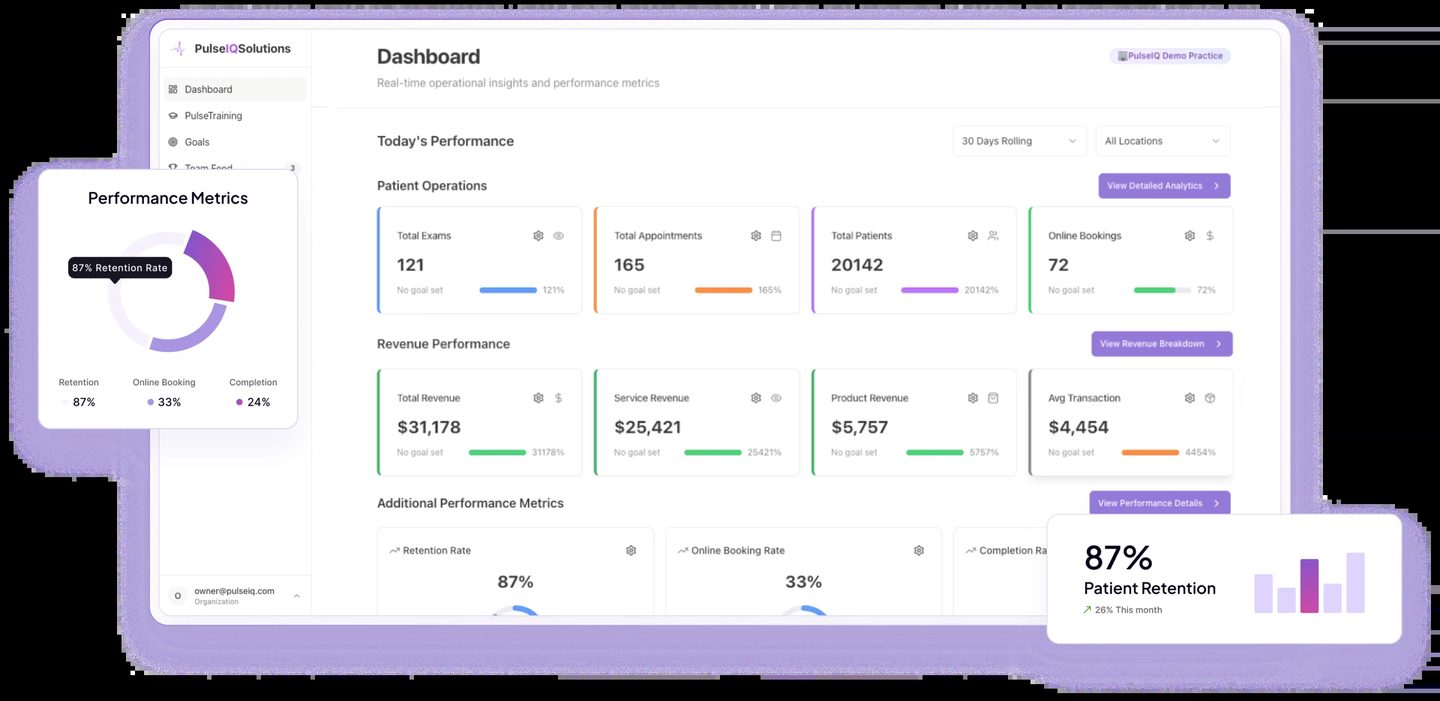
The dashboard I run my own practices on.
One place for daily revenue against goal, patient volume, spend per patient and retention, with role-based training built in. I built it because I couldn't buy it. Advisory clients can implement it as their operating dashboard, and any practice can use it on its own.
pulseiqsolutions.comSimple, on purpose.
No 40-page proposal. The first conversation is to find out whether I can genuinely help, and what the first constraint is.
- Conversation. Thirty minutes on where the business is, what's frustrating, and what "better" looks like in twelve months.
- Diagnostic. A short look at the numbers, the roles and the cadence.
- Focus. One constraint, a plan to fix it, and the scorecard that shows it's fixed.
- Cadence. Working sessions with the owner and leadership team, with real work between them.
- Is this only for optometry?
- No. My experience is in optometry, and the lessons transfer directly to any owner-led healthcare organization: dental, physiotherapy, chiropractic, veterinary, medical aesthetics and multi-site primary care.
- Do you work with groups outside Ontario?
- Yes. Most of the work happens virtually, with on-site sessions where they add value.
- Does this include PulseIQ?
- It can. PulseIQ is the dashboard and training platform I built for my own practices, and in most operating-system engagements we implement it as the live scorecard, so the numbers we agree on are visible to your team from day one. If you already have reporting you trust, we work with that instead.
Let's build something better.
Building a healthcare organization, or building an event for the people who lead them? Either way, I'd like to hear about it.